March 25, 2026
The Giant in the Sky: Why Isn't Solar Powering Everything Yet?
Solar energy could theoretically power the world with just 0.02% of land, yet it only provides 7% of our electricity. Here's why the transition is taking time.
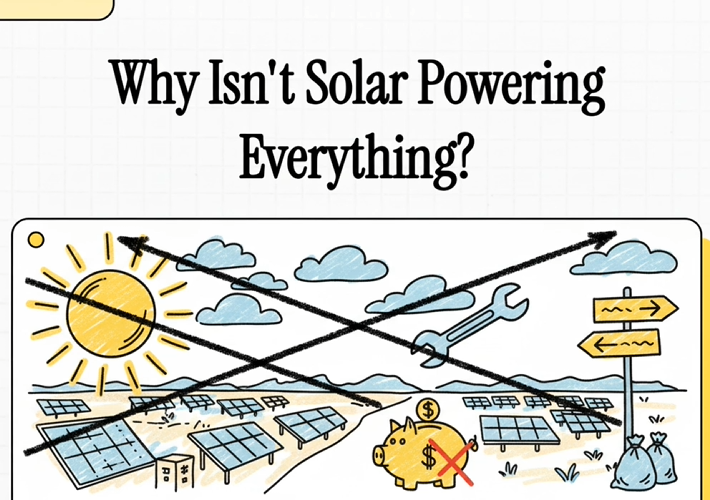
Imagine a power source so vast that covering just 0.02% of the world’s land—about 30,000 square kilometers—with current technology could theoretically meet the entire planet’s electricity demand[1]. Even better, solar energy is expanding at a breakneck pace; in 2024 alone, solar generation grew by 30%, adding enough power to reach a total of 2,000 Terawatt-hours (TWh)[2].
Yet, despite this abundance and the fact that solar is now the fastest-growing energy source, it currently only accounts for 7% of the world’s total electricity generation[2]. If the sun provides more than enough energy and the technology is getting cheaper, why aren’t we 100% solar already?
The Growth Sprint vs. The Global Appetite
The world’s hunger for electricity is growing fast, rising by 4.3% in 2024[3]. According to the International Energy Agency (IEA), this demand is being driven by the “electrification” of everything—from the cars we drive to the massive AI data centers that power our digital lives[1].
While global demand is growing at about 4% annually, solar PV adoption is sprinting ahead at a 25% annual growth rate[2]. In fact, solar is expected to meet roughly half of all new global electricity demand growth through 2027[1].
Quick Recap:
- The Potential: We only need a tiny fraction of land (0.02%) to power the world[1].
- The Reality: Solar currently provides about 7% of our power, up from 5% just a year ago[2].
- The Momentum: Solar’s 25% growth rate is far outpacing the 4% increase in how much electricity the world uses[2].
The Speed Bumps: Storage and the Grid
If solar is growing so fast, what’s the hold-up? The first major challenge is intermittency. The sun doesn’t shine at night, and our current global battery storage—roughly 200 Gigawatt-hours—is nowhere near enough to support a grid dominated by solar[4].
Even though battery costs have dropped 90% since 2010, they still cost around $300 per kilowatt-hour (kWh) as of 2024[4]. This price tag makes 24/7 solar power an expensive goal to reach for many regions.
Then there is the electrical grid. Our power lines were built for old-fashioned, centralized coal and gas plants. To handle decentralized solar from millions of rooftops, the International Renewable Energy Agency (IRENA) estimates we need $1.3 trillion in global grid upgrades by 2030[5]. Without these upgrades, we actually waste energy; in 2024, California had to “curtail” (or throw away) 5% of its total solar generation because the grid couldn’t handle the surge[6].
Important Fact to Remember: We need over $1 trillion in grid upgrades to stop wasting the solar power we already produce[5].
Land, Laws, and Money
Even though the land requirement is small, getting permission to use it is a headache. In the U.S., solar projects can face 2 to 5 years of permitting delays due to regulations or local resistance[7].
Additionally, the financial playing field isn’t level. Global subsidies for fossil fuels reached $1 trillion in 2023, which is double the $500 billion in support given to renewable energy[8]. These “policy hurdles” and supply chain snags—like a 25% spike in module prices in 2024 due to material shortages—can temporarily stall the transition[2].
The “Green High-Five”: Agrivoltaics
There is a clever solution emerging for the land-use debate: agrivoltaics. This is where solar panels share space with crops or grazing animals. It keeps the land productive for farming while the shade from the panels actually cools them down, which boosts the panels’ efficiency. It’s a literal win-win for farmers and the environment.
Quick Recap:
- Storage: Batteries are still a barrier at $300/kWh[4].
- The Grid: We are outgrowing our old infrastructure and need massive investment[5].
- Policy: Fossil fuel subsidies still outweigh renewable support two-to-one[8].
A Bright Path Ahead
It can be easy to look at a $1.3 trillion infrastructure bill and feel overwhelmed. But let’s step back and look at how far we’ve come. We are now installing a new gigawatt of solar capacity every 15 hours[2]. In the U.S., solar accounted for a staggering 77.7% of all new electricity capacity added in 2025[7].
We are living through a dynamic, evolving story. While solar isn’t powering everything yet, it is the fastest-growing energy source on the planet[2]. With innovations like agrivoltaics and the continued drop in technology costs, the path forward is clear. The “Giant in the Sky” is finally being put to work, and the future looks incredibly bright.
References
[1] IEA Electricity 2025 Executive Summary
[2] PV Magazine - Solar Generation Growth 2024
[3] IEA Growth in Global Electricity Demand
[4] BloombergNEF. (2024). Battery Price Survey 2024.
[5] IRENA. (2023). Renewable Power Generation Costs in 2023.
[6] CAISO. (2024). California ISO Annual Report.
[7] SEIA. (2024). Solar Market Insight Report 2024.
[8] IPCC. (2022). Climate Change 2022: Mitigation of Climate Change.